
If you’ve sat through any “future of HR” webinar in the last two years, you’ll have heard the same prediction on repeat: AI is going to transform recruitment. Smart screening, automated interviews, AI-shortlisted candidates – the works.
It’s a tidy story. But it’s not what HR people themselves are most excited about.
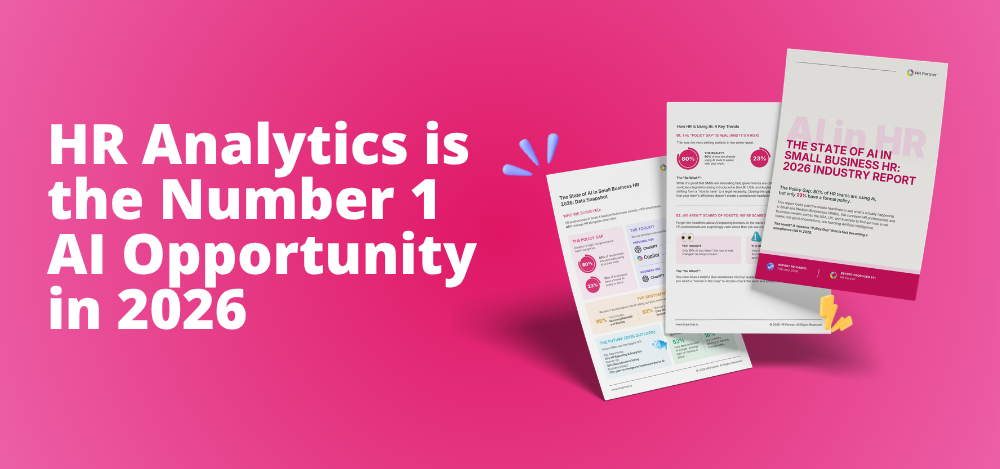
According to HR Partner’s 2026 State of AI in Small Business HR Report – our independent survey of HR professionals and business owners across Australia, the UK, and the US 41% of respondents chose HR Reporting and Analytics as the area where AI will have the biggest impact in 2026.
That puts it ahead of recruitment (38%), learning and development (29.6%), and onboarding (27.2%).
Small businesses don’t just want AI to help them hire. They want AI to help them understand their people.
So while the headlines are still talking about AI hiring tools, small businesses are quietly placing their bets somewhere else: making sense of the data they already have.
There’s just one problem – and it’s a big one. Most SMB HR data is nowhere near ready for it.
Why is HR analytics the #1 AI opportunity for small businesses?
A few things came through clearly in the data and the qualitative responses we collected.
Analytics has been out of reach for small businesses – until now. Big companies have had people analytics teams for a decade. Small businesses haven’t. They’ve had a manager with a spreadsheet. AI changes that economics overnight – suddenly, you don’t need a data team to ask “why did three people in our Sydney office leave this quarter?”
Recruitment is occasional. Analytics is constant. Most small businesses aren’t hiring every week – they hire in bursts. But people, leave, performance and turnover are happening all the time. AI that helps you understand your team is useful every Monday morning. AI that helps with hiring is useful when you’re hiring.
It compounds. Insights about your people get more valuable the longer you collect them. A useful AI looking at three years of leave data can spot patterns no human reasonably could. Recruitment AI helps with one hire at a time. Analytics helps with every decision you make about your team, for years.
The qualitative responses backed this up. When we asked respondents about the biggest opportunity for AI in their business, themes around data analysis, workforce planning, and turning employee data into insights came up again and again – more often than recruitment did.
So what’s the catch?
Here’s the awkward truth nobody really mentions in the AI hype cycle: you can’t run analytics on data that doesn’t exist in one place.
And in most small businesses, HR data looks something like this::
- A spreadsheet called staff_list_FINAL_v3.xlsx
- Another spreadsheet someone exported six months ago
- A shared folder somewhere on Google Drive (you think?)
- Payroll notes sitting in a sequence of email threads with the bookkeeper
- A handwritten note from the team offsite that said something important about turnover
- Half the context living in the HR person’s head
That’s not a setup AI can do anything useful with. Feed scattered, inconsistent, half-finished records to an AI and you don’t get insights – you get confident-sounding nonsense, dressed up in a chart.
AI has changed how fast businesses can analyze data. It hasn’t changed the quality of the underlying data itself.
Garbage in still means garbage out. The garbage just arrives faster now.
What HR data needs to look like before AI can help
Before AI analytics is useful, your people data needs three things:
- To exist in one place. Not three places. Not “mostly here, but also that one bit Sarah keeps.” One source of truth.
- To be structured consistently. Same field names. Same date formats. Same definition of “department” used by everyone.
- To be accurate and current. AI doesn’t fix bad data – it amplifies it. A confident wrong answer is worse than no answer at all.
The Future of AI in HR Depends on Some Very Unexciting Work
If that sounds boring, that’s because it is. It’s also the foundation layer that makes everything else possible. The small businesses that get genuine value from AI in 2026 won’t be the ones with the fanciest AI tools. They’ll be the ones whose data was actually in shape to start with.
Which is more important – the AI tools or the data?
The data. By a long way.
The AI tools market is going to keep moving fast. Whatever’s hot in early 2026 will be replaced by something better by mid-2027. Building your strategy around a specific tool is a losing game.
But your people data? That’s yours. It compounds. Every month of clean, structured, centralized employee records becomes another month of context you (or a future AI tool) can draw on. The earlier you start, the more valuable it gets.
That’s why the small businesses we work with at HR Partner tend to focus on the unsexy bit first: getting their team data out of spreadsheets and into a system. Not because it’s exciting, but because everything else – reporting, analytics, eventually AI insights – depends on it.
What can small businesses do right now to prepare for AI analytics?
You don’t need to wait for AI to start getting value out of your people data. Three steps make a real difference:
Centralize first. Get employee records, leave history, performance reviews, recruitment pipelines and onboarding records into one system. Not because AI needs it – because you need it. AI is just the bonus that comes later.
Standardize as you go. Same fields, same formats, same categories across teams. The cleaner the structure, the more useful the data becomes – to humans now, to AI later.
Build the reporting habit. Run actual reports on your people data, even if it’s just monthly. Turnover by team. Time-to-hire. Leave balance trends. The act of looking at the numbers regularly is what surfaces what’s worth tracking – and it’s what you’ll want AI helping you with the moment the right tools arrive.
The 41% who picked analytics as the top AI opportunity for 2026 are looking in the right direction. They’re just going to need their data house in order before they get there.
The ones who start now will be ready. The ones still managing their team in twelve different spreadsheets won’t be.
Get the Full Picture
Our 2026 State of AI in Small Business HR Report breaks down the full survey – regional comparisons across Australia, the UK, and the US, the tools small businesses actually use, and where HR teams see AI making the biggest impact in the year ahead.
Explore the full 2026 report, including where SMB HR teams see AI creating the biggest impact, the barriers holding adoption back, and how priorities differ across Australia, the UK, and the US.
Download the report – no email required
Get your people data in one place
HR Partner is a purpose-built HR management system for growing teams of 20-500 employees. Founded in Australia and used by organizations around the world, we bring all the essentials of HR – employee records, leave, recruitment, onboarding, performance reviews and more – into one simple platform. So when you’re ready to do something useful with your people data, it’s all in one place.
Book a demo or Start a free trial
Frequently Asked Questions
What is HR analytics?
HR analytics is the practice of turning data about your people – turnover, leave, performance, hiring, engagement – into insights that help you make better decisions about your team.
Why is HR analytics the top AI opportunity for 2026?
According to HR Partner’s 2026 report, 41% of small business HR professionals chose HR Reporting and Analytics as the area where AI will have the biggest impact, ahead of recruitment (38%) and learning and development (29.6%).
Can AI run analytics on my existing HR data?
Only if your data is centralized, structured, and accurate. AI tools amplify whatever data you give them – so if employee records are scattered across spreadsheets and folders, the insights won’t be reliable.
What HR data should small businesses be tracking?
The basics first: employee records, leave history, turnover, time-to-hire, and performance review outcomes. The longer you track these consistently, the more useful the data becomes for analysis – whether by humans or eventually by AI.
How do small businesses prepare for AI in HR?
Centralize your people data into one system, standardize how it’s recorded across teams, and build a habit of running regular reports. The teams that have their data house in order will get value from AI tools much faster than teams still working out of spreadsheets.
Statistics in this article come from HR Partner’s 2026 State of AI in Small Business HR Report – based on responses from HR professionals and business owners across Australia, the UK, and the US, surveyed between November 2025 and January 2026.