
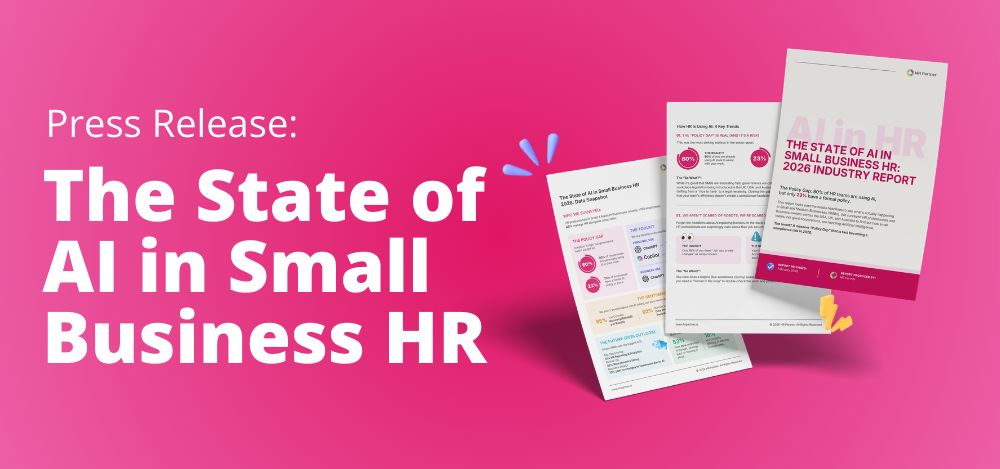
New report reveals that small business HR is innovating rapidly, but formal governance hasn’t caught up.
Darwin, AUSTRALIA – February 19, 2026 – A new report released today by HR Partner, uncovers a distinct trend in the small business sector: HR teams are adopting Artificial Intelligence at a rapid pace, often outpacing their own internal rulebooks.
The report, titled The State of AI in Small Business HR 2026, surveyed HR professionals and those with HR responsibilities in Small and Medium Businesses (SMBs) across the UK, USA, and Australia. The findings show a massive disconnect between usage and governance: while 80% of respondents are using AI to help with their daily work, only 23% of businesses have a formal policy in place to guide them.
Speed vs. Safety
This AI “policy gap” suggests that small business teams are prioritizing agility and efficiency. They are picking up tools to solve immediate problems, like drafting job descriptions or summarizing meetings, without waiting for formal approval processes.
However, without guidelines, these businesses face a hidden risk. The report highlights that while usage is high, training is low, with 53% of businesses having no AI budget or training strategy in place.
A Shift in Responsibility
This gap comes at a time of increasing global oversight regarding workplace technology. In 2026, the responsibility for AI-driven outcomes, such as recruitment fairness and data security, sits squarely with the employer.
As regulators move from voluntary guidelines to active enforcement, businesses are now being held accountable for the “digital assistants” their teams use. For many SMBs, the lack of a formal policy isn’t just an internal oversight; it is a significant legal and data risk that is currently going unmonitored.
Fiona Adler, Co-Founder at HR Partner, commented:
“The data tells us that small businesses aren’t waiting for permission to innovate. They are grabbing AI tools with both hands to help with their workload.
“The gap between the 80% adoption and the 23% policy rate isn’t necessarily about negligence; it’s about speed. HR teams are moving fast to be more efficient. The challenge for 2026 isn’t to slow them down, but to put the simple guardrails in place – like an AI usage policy – so they can keep moving fast without putting data, or their companies, at risk.”
Key Findings:
- The Reality of Usage: Adoption is widespread, with 80% of HR professionals using AI tools. This challenges the idea that small businesses are lagging behind on tech.
- The “Job Loss” Myth: The drive for AI is about support, not replacement. Only 10% of respondents listed job losses or changes as a concern. The primary worries are practical: Accuracy or Reliability of Results (65%) and Data Privacy or Security Risks (62%).
- The Next Frontier: While today’s usage is about writing and admin, the future is strategic. Respondents identified HR Reporting & Analytics (41%) as the biggest opportunity for the next 12 months.
Regional Snapshots:
- United States: The most future-focused region, with teams identifying Analytics as their #1 opportunity to gain a competitive edge.
- United Kingdom: The most stable market, with 85% of businesses planning no changes to headcount, focusing on efficiency.
- Australia: Leading the way on governance, with Australian businesses being the most likely to have already implemented a formal AI policy (30%).
# # #
Media Contact:
Debbie Gainsford
HR Partner
About the Report
For The State of AI in Small Business HR 2026, HR Partner surveyed HR professionals and those with HR responsibilities in small and medium-sized businesses (20-500 employees). The study tracks how these teams across the UK, USA, and Australia are using Artificial Intelligence, providing a snapshot of how small businesses are navigating technology, policy, and employer responsibility in 2026. The full report is available for download here.
About HR Partner
HR Partner (hrpartner.io) provides a streamlined HR management platform tailored specifically for the needs of small and medium-sized businesses. By automating administrative tasks – including recruitment, onboarding, leave tracking, and records management – HR Partner allows growing teams to focus on their people rather than paperwork. Designed as a simple, powerful alternative to complex enterprise systems, the platform’s impact was recently solidified by its inclusion in G2’s Top 50 Best Products for Australia and New Zealand 2026, joining the ranks of industry leaders such as Canva, Xero, and Atlassian.
For more information, visit hrpartner.io.